
Boom lift vs scissor lift at a glance
| Feature | Boom lift | Scissor lift |
|---|---|---|
| Movement | Up, out and around: the boom swings, extends and on many models bends over obstacles. | Straight up and down only. |
| Height | From about 30 ft on small booms to 300 ft on truck-mounted lifts like ours. | Usually up to about 60 ft. |
| Side reach | Yes. Our A‑300 reaches 137 ft to the side. | None beyond a short roll-out deck extension. |
| Platform | A basket for one to a few people. Ours are up to 12 ft long. | A wide deck for several people and materials. |
| Where it stands | Can stand away from the work: on the street, behind a fence, across a lower roof. | Must stand directly under the work, on firm, level ground. |
| Fall protection | Harness and lanyard clipped to the basket (OSHA 1926.453). | Guardrails are the primary fall protection; OSHA covers most scissor lifts under its mobile scaffold rules. |
| Cost | Higher per day, but one setup often reaches what would otherwise take several moves or another method. | Lower per day for low, overhead work. |
What is a scissor lift?
A scissor lift raises a deck on crisscrossed supports that extend like an accordion. It only moves vertically, so the machine has to stand directly under the work. In exchange, the deck is wide and stable, holds several workers with their materials, and most models have a deck extension that rolls out a few feet.
- Electric (slab) scissor lifts: narrow, quiet and emission-free, for indoor work on smooth floors.
- Rough-terrain scissor lifts: diesel or dual-fuel, often with four-wheel drive and outriggers, for construction sites.
OSHA covers most scissor lifts under its scaffold rules as mobile scaffolds (1926.452(w)): guardrails around the deck are the main fall protection, and the lift must be used on firm, level ground, away from holes, drop-offs and overhead lines.
What is a boom lift?
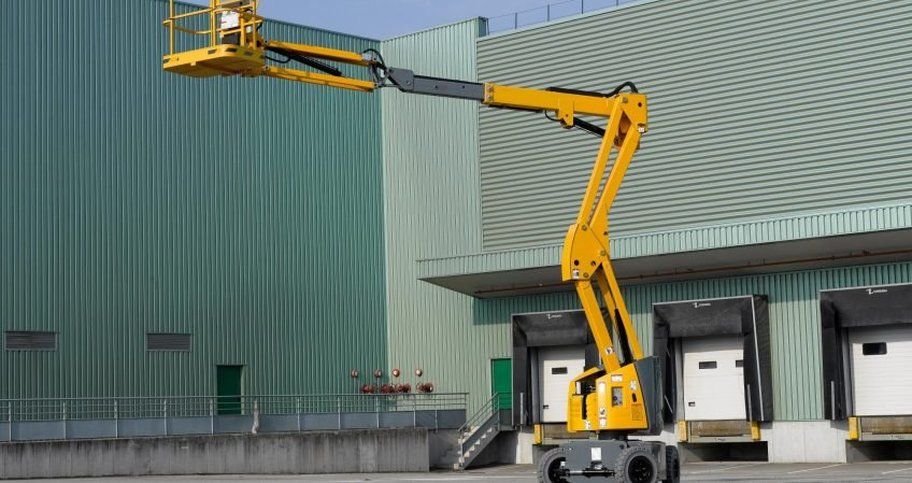
A boom lift carries a basket at the end of a hydraulic arm on a rotating base. It can raise the basket, swing it around and move it out to the side, so the machine can stand away from the work.
- Telescopic (straight) booms: the most height and outreach from one spot.
- Articulating (knuckle) booms: bend up and over parapets, roofs and machinery.
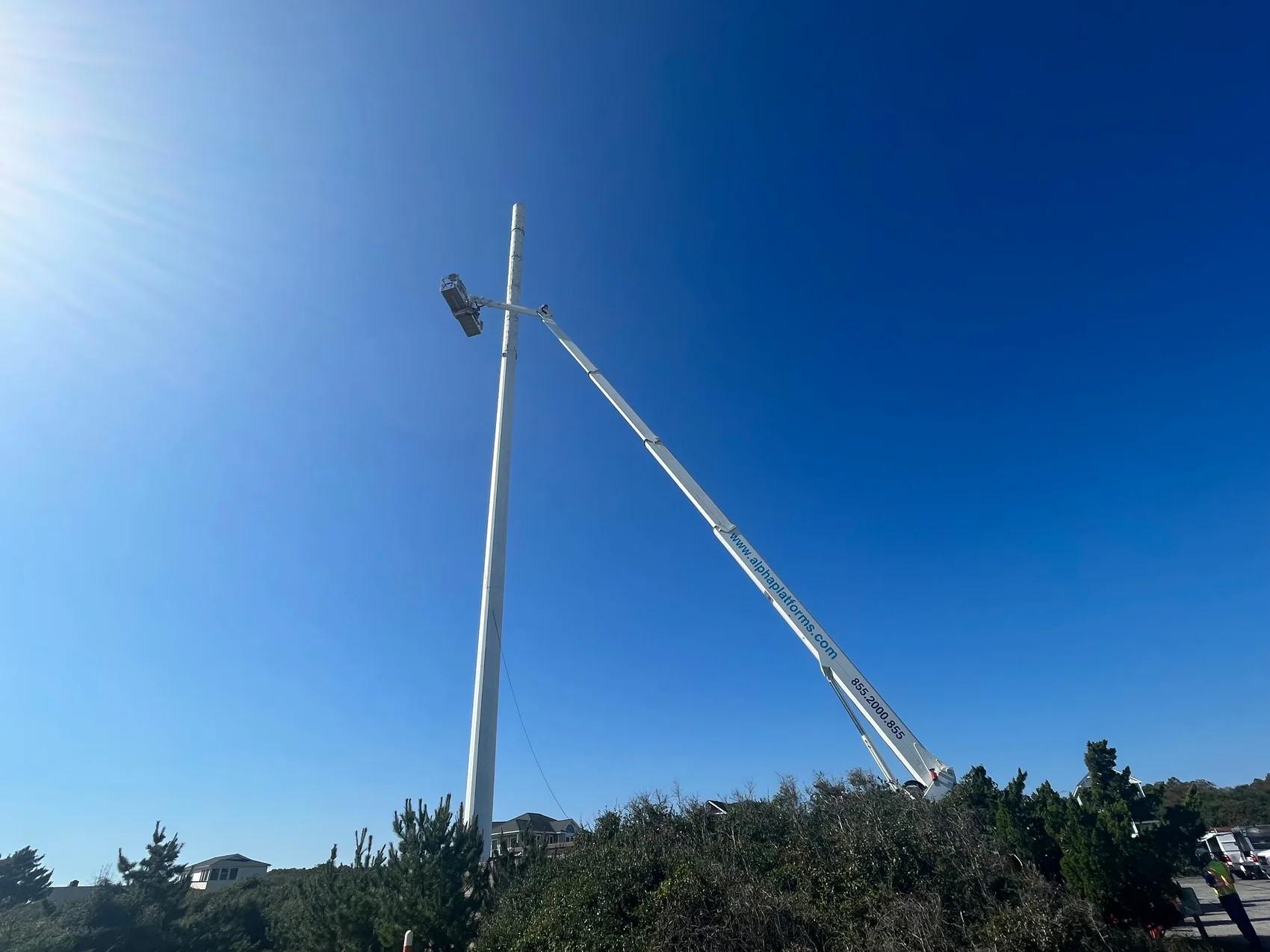
- Truck-mounted booms: drive to the job on the road and set up on outriggers. They combine a telescopic boom with an articulating jib, and reach far higher than self-propelled machines.
See telescopic or articulating boom lift and types of aerial work platforms.
When to rent a scissor lift
- The work is directly overhead: ceilings, ductwork, sprinklers, lighting in a warehouse or atrium.
- Several people need to work side by side with materials, for example drywall or ceiling grid.
- The floor is flat and solid right up to the work.
- The height is within about 60 ft.
- The job is indoors, where an electric machine avoids exhaust and noise.
When you need a boom lift
- The work is high: facades, towers, smokestacks, anything above the reach of a scissor lift.
- There is something in between: a lower roof, a canopy, a loading dock, a fence, landscaping or a sidewalk shed.
- The ground under the work is not usable: a slope, soft ground, water, traffic, or a wall that does not face the street.
- The basket has to follow the work along a facade or around a structure without moving the machine.
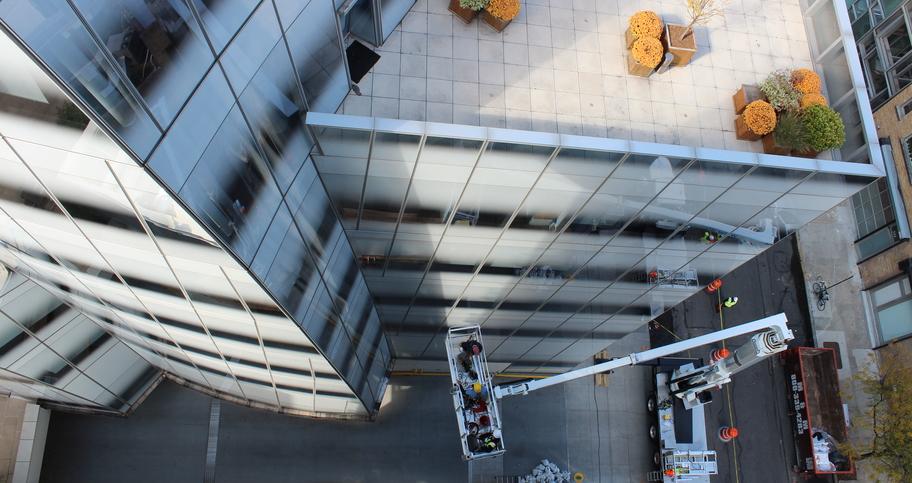
In Philadelphia, a masonry firm had to repair a brick wall of the Land Title Building that does not face the street. Working from the roof would have meant an extra-long swing stage. Our A‑150 parked on a narrow one-way street, set up in 15 minutes and reached up and over the roof to the wall. Two masons worked with bricks, mortar and tools in the 12 ft basket, and they finished the job in one day from a single setup.
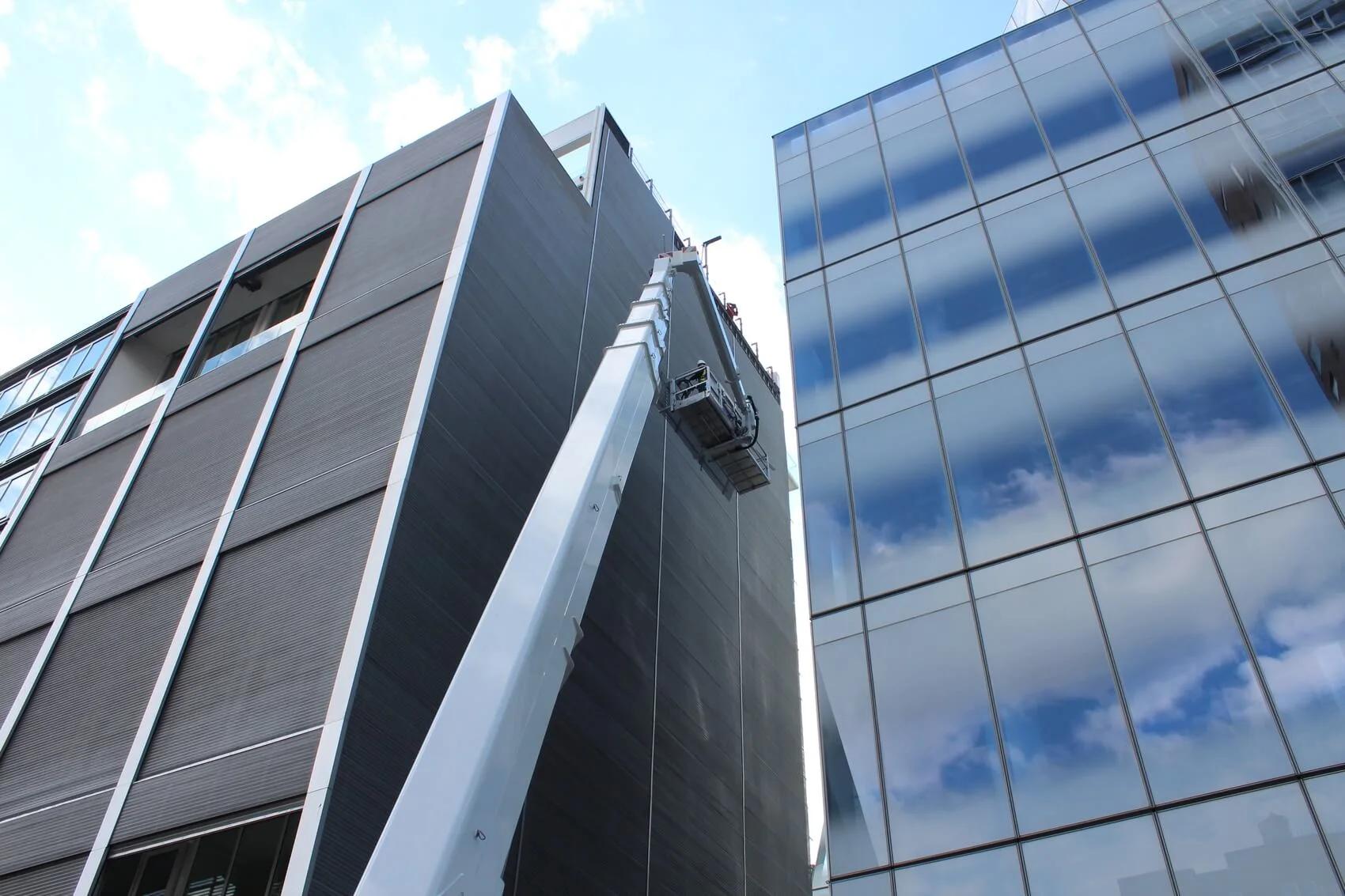
In New York, 15 ft decorative panels had to be installed on a 9-story building next to the glass IAC Building, across a sloped driveway 10 to 22 ft wide. No crane or manlift fit. Our A‑230 covered both sides from one spot, bottom floor to roof.
Cost: which is cheaper?
Per day, a scissor lift costs less than a boom lift of similar height, and a small boom less than a truck-mounted one. The real comparison is the whole job: how many moves, setups and days it takes, and whether the work also needs a swing stage, scaffolding or a crane. A taller lift that finishes from one setup can cost less overall than a cheaper machine that has to be repositioned all day. See boom lift rental cost.
Safety differences
- Boom lift: full body harness with a lanyard clipped to the basket, never to a nearby structure. Stand on the basket floor.
- Scissor lift: keep the guardrails and gate closed, do not stand on the rails or use ladders on the deck, and do not drive with the deck raised near holes, slopes or drop-offs. Follow the manufacturer's rules on harness use.
- Both: trained, authorized operators, a check before every shift, load and wind limits, at least 10 ft from power lines.
More in how to operate a boom lift safely.
Our boom lifts
We rent truck-mounted boom lifts from 150 to 300 ft with a certified operator, permits and traffic control. If your job is beyond a scissor lift, compare the fleet or check your height and distance with the reach calculator.
Quick answers
What is the difference between a boom lift and a scissor lift?
A scissor lift only goes straight up, with a wide deck for several people directly over the machine. A boom lift moves a basket up, out and over obstacles, so it reaches higher and can stand away from the work.
Which is safer, a boom lift or a scissor lift?
Both are safe when used correctly. On a boom lift you wear a harness clipped to the basket; on a scissor lift the guardrails are the main fall protection. Each has its own rules for ground, load and wind.
Do you need a harness on a scissor lift?
OSHA covers most scissor lifts under its mobile scaffold rules, so guardrails are the primary fall protection. Some manufacturers and employers also require a harness, so follow the manual and your site rules. On a boom lift a harness is required.
How high can a scissor lift go?
Usually up to about 60 ft. For more height, or for any side reach, you need a boom lift.
Is a boom lift more expensive than a scissor lift?
Per day, yes. But a boom lift that reaches the work from one setup can cost less for the whole job than a scissor lift that has to be moved repeatedly, or another method such as scaffolding.